Why Your Rings Are Tight in the Morning and Loose by Evening - and Your Ankles Do the Opposite
Quick Answer: Your lymphatic system has no pump. It moves fluid using muscle contraction, breathing, and body position - which means when you stop moving, fluid stops moving, and it settles wherever gravity puts it. Lying flat all night, gravity distributes fluid toward your hands and face. Standing and sitting all day, it settles into your ankles.
The reversal through the day is normal and expected. What is not: swelling in one limb only, swelling that does not resolve, or swelling that leaves a deep pit when pressed.
Here is the mechanism, what changes it, and where the line for a clinician sits.

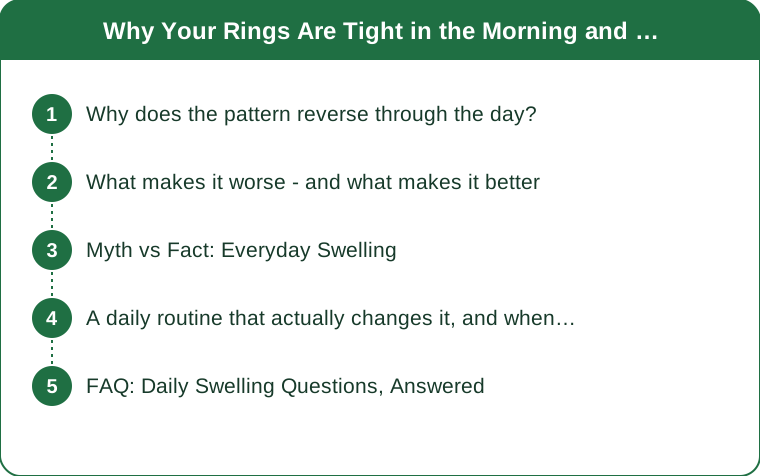
Why does the pattern reverse through the day?
Because position determines where fluid goes, and movement determines whether it comes back.
The lymphatic system has no heart. Unlike blood, lymph has no central pump. It relies on skeletal muscle contraction squeezing the vessels, the pressure changes of breathing, and one-way valves to move fluid back toward the chest. Stop moving and the system largely stops.
Overnight, you are horizontal and still. Gravity no longer pulls fluid toward your feet, so it redistributes toward the upper body - hands, fingers, and face. Your muscle pump is switched off for eight hours, so nothing is actively clearing it. This is why rings are tightest and faces are puffiest first thing.
By mid-morning it has resolved. Moving around switches the pump back on and gravity resumes pulling downward. Most people’s hand swelling clears within an hour or two of getting up.
Through the day it accumulates downward. Standing or sitting for hours means gravity is working against return flow from the legs continuously. By evening, ankles and feet are at their most swollen - and the more still you were, the worse it is. A day at a desk produces more ankle swelling than a day on your feet walking.
And the calf muscle is the main pump for the lower body. Every step compresses the deep veins and lymphatics of the calf and pushes fluid upward. Sitting still removes that entirely, which is why a long flight or a long meeting produces such noticeable results.
What makes it worse - and what makes it better
The same short list appears behind most of the day-to-day variation people notice.
What makes it worse:
- Stillness, in any position. The single largest factor. A long flight, a long drive, a day at a desk, a night’s sleep
- Heat. Blood vessels dilate in warm weather, which increases fluid leakage into the tissue. This is why late summer is the worst season for it and why the same shoes fit differently in August
- High sodium intake the day before, which increases fluid retention
- Hormonal cycle phase. Fluid retention is commonly higher in the luteal phase, and many people can predict it
- Alcohol, which affects fluid balance and often shows up the next morning in the face and hands
- Long periods with the arms below the heart, which is why swelling can be worse after a day of carrying things
What makes it better:
- Movement, above everything. Walking is the most effective lymphatic intervention there is and it is free
- Elevation. Legs above heart height for 10 to 15 minutes does more for ankle swelling than anything you can rub on it
- Deep diaphragmatic breathing. The pressure change across the diaphragm is a genuine driver of central lymph flow - ten slow breaths is a real intervention, not a wellness gesture
- Compression. Graduated compression socks have solid evidence for travel and prolonged standing
- Cool temperatures, which is why swelling is better in autumn
And what does very little: dry brushing, most drainage tools, and detox products. Manual lymphatic drainage performed by a trained therapist has genuine evidence in clinical contexts - the at-home versions being sold as equivalent are mostly not.

Myth vs Fact: Everyday Swelling
Myth: Swelling means you are retaining toxins. Fact: It means fluid has accumulated in the tissue faster than it is being returned. That is a mechanical and circulatory matter, and the lymphatic system is not a detox organ in the way wellness marketing suggests - your liver and kidneys handle that.
Myth: Drinking less water reduces swelling. Fact: The opposite, generally. Dehydration causes the body to retain more fluid. Adequate hydration with reasonable sodium intake is the position that reduces swelling, not restriction.
Myth: Dry brushing moves lymph. Fact: The evidence is thin to non-existent. Skin brushing may feel pleasant and may briefly redden the skin; there is little to suggest it meaningfully moves lymph. Ten minutes of walking does considerably more.
Myth: Morning puffiness means something is wrong. Fact: Mild, symmetrical, self-resolving morning puffiness is ordinary physiology. What matters is asymmetry, persistence, and pitting - see below.
Myth: Compression socks are only for medical conditions. Fact: They are well supported for travel, prolonged standing, and exercise recovery in general populations. Graduated compression is the type that matters; a tight non-graduated sock can restrict rather than assist.
A daily routine that actually changes it, and when to see someone
The routine, which takes about 15 minutes across a whole day:
- Morning, before getting up: 20 ankle pumps and 10 slow diaphragmatic breaths. Switches the pump on before you stand
- Every hour you are seated: stand and walk for two minutes, or do 20 calf raises at your desk. This is the highest-value habit on the list and it fits inside any job
- Midday: a short walk. Ten minutes does more than any product
- Evening: legs up the wall for 10 to 15 minutes. Simple, effective, and the most reliable intervention for ankle swelling
- Before bed: 10 slow diaphragmatic breaths
For specific situations:
- Flights and long drives: graduated compression socks, ankle pumps every 30 minutes, and get up when you can
- Hot weather: more frequent movement, cooler footwear, and elevation in the evening
- Long standing days: compression, and elevation afterward rather than during
When it warrants a clinician rather than a routine:
- Swelling in one limb only, particularly if it is sudden, warm, red, or painful. This can indicate a clot and is urgent
- Swelling that leaves a deep indentation when pressed and is slow to fill back in
- Swelling that does not resolve overnight or with elevation
- Swelling with breathlessness, chest discomfort, or a sudden change in how much urine you produce
- New persistent swelling after surgery, injury, or cancer treatment, which needs specific assessment
- New facial or hand swelling that persists all day rather than resolving by mid-morning
Ordinary daily variation that resolves is one thing; persistent, asymmetric, or pitting swelling is another, and the second belongs with a professional rather than with a routine. This is general information, not medical advice.
FAQ: Daily Swelling Questions, Answered
Why are my hands worse on days I sleep in?
More hours horizontal and still means more fluid redistributed upward and less pump activity clearing it. It usually resolves faster than it built up, once you are up and moving.
Do compression gloves help morning hand swelling?
For some people, and they are far less commonly needed than compression socks. Ankle pumps and simply getting up and moving typically resolve ordinary morning hand swelling within an hour without any equipment.
Is it worse in late summer specifically?
Yes, and noticeably - heat dilates blood vessels and increases fluid leakage into tissue, so the same day’s activity produces more swelling in August than in October. It is the single most common reason people notice this in the first place.
Does exercise make it better or worse?
Better during and after, because the muscle pump is the mechanism. Some people notice mild swelling immediately after intense exercise from increased blood flow, which resolves quickly and is different from the fluid accumulation described here.
TL;DR:
- Lymph has no pump - it relies on muscle contraction, breathing, and body position
- Lying flat overnight sends fluid to hands and face; sitting all day sends it to ankles
- Movement is the single most effective intervention, and stillness is the main cause
- Legs up the wall, hourly walking, and diaphragmatic breathing all genuinely work
- One-sided swelling, pitting, or swelling that does not resolve needs a clinician, not a routine
Set an hourly reminder to stand and do 20 calf raises tomorrow, then check your ankles at 6pm. The difference is usually obvious in a day.
Keep Reading
This article is for general informational purposes only and is not medical advice. Always consult a qualified health professional for guidance specific to you.