Why Your Hands Swell on a Hot Walk But Not During a Run
Quick Answer: Heat opens the blood vessels in your hands so you can dump warmth, and walking gives your arms almost no muscular pumping to move that fluid back. During a run, your arms swing vigorously and your muscles contract rhythmically, which drives venous and lymphatic return. Add gravity: hands hang low and still on a walk. The result is fluid arriving faster than it leaves. It is common, generally harmless, and it responds well to simple movement.
An hour into a hot afternoon walk your rings are tight and your fingers feel like sausages. You ran five miles yesterday in the same heat and nothing happened.
The difference is not intensity. It is what your arms were doing.

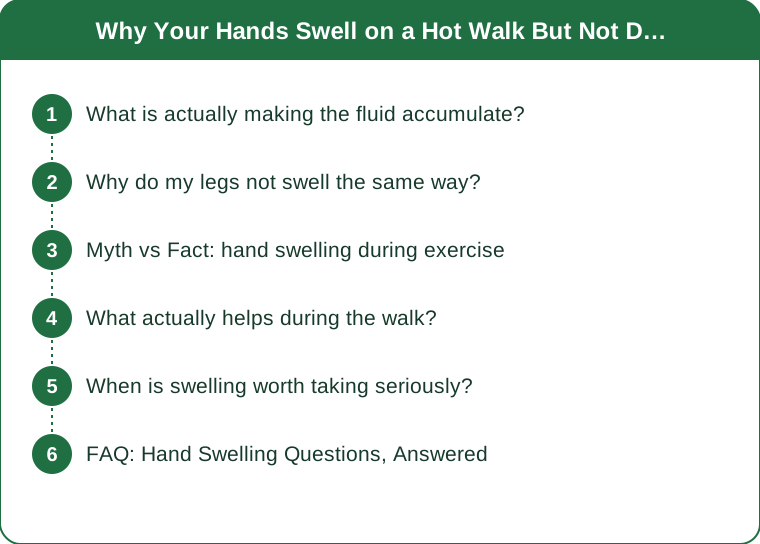
What is actually making the fluid accumulate?
Three things arriving together, all of them normal.
Heat causes vasodilation in the hands. Your hands and feet are major heat radiators. In warm weather, blood flow to them increases substantially so you can shed warmth to the air. More blood in the vessels means more fluid pressure pushing outward into the surrounding tissue.
Gravity keeps it there. On a walk your arms hang at your sides, below heart level, for an hour. Fluid pools in the lowest, least active part of the circuit.
Your arms do almost no pumping. This is the key part. Veins and lymphatic vessels have no pump of their own in the limbs. They depend on surrounding muscle contraction to squeeze fluid back toward the heart, assisted by one-way valves. Walking contracts your calves rhythmically, which is why your legs generally do fine, and does almost nothing for your forearms.
During a run, your arms swing through a large range with real muscular effort, and that provides the pump the walk was missing.
Why do my legs not swell the same way?
Because the calf muscle pump is one of the most effective mechanisms in the body, and walking uses it constantly.
Every step contracts the calf, which squeezes the deep veins and pushes blood upward against gravity. Valves prevent backflow. This is sometimes called the second heart, and it is doing a great deal of work every time you walk.
Your arms have nothing equivalent happening during a walk. They swing gently, if at all, and the small movement produces very little compression of the vessels.
The comparison people find convincing: sit still in a warm room with your hands hanging by your sides for an hour and you will get some of the same effect without walking at all. It is not the walking that causes it, it is the combination of heat, dependency and stillness that walking happens to produce in the upper body.
Myth vs Fact: hand swelling during exercise
Myth: It means you are drinking too much water. Fact: For most people, this is local fluid distribution rather than total body fluid excess. Restricting fluid in heat is counterproductive and occasionally dangerous.
Myth: It means you are dehydrated. Fact: Also not usually the cause, though dehydration can contribute to poor circulation and to sodium imbalance if you are sweating heavily and drinking only plain water on long efforts.
Myth: Swinging your arms fixes it because it shakes the fluid out. Fact: It works, but not by shaking. It works by contracting the muscles that squeeze the vessels. Active movement beats passive shaking every time.
Myth: Salt causes it and you should cut back before a walk. Fact: In hot weather with heavy sweating, inadequate sodium is more often a problem than excess, particularly on longer efforts where you are drinking plain water. Very low sodium relative to fluid intake can worsen swelling.
Myth: It is a lymphatic problem that needs massage. Fact: Occasional exercise-related hand swelling in hot weather is normal circulation, not lymphatic dysfunction. Persistent one-sided swelling is a different matter entirely.

What actually helps during the walk?
Simple mechanical things, and they work within minutes:
-
Swing your arms deliberately. A full, purposeful arm swing rather than a passive hang. This alone resolves it for many people.
-
Open and close your fists 20 times, several times during the walk. Direct forearm muscle pumping, and it works fast.
-
Raise your hands above your heart periodically. Hands on your head for 30 seconds, or arms overhead. Gravity does the work.
-
Take off tight rings before a hot walk, not during. Once swelling is established, removal is harder and occasionally requires help.
-
Carry something light and switch hands. Holding a bottle gives your grip muscles something to do.
-
Use walking poles if you walk long distances. They engage the upper body continuously and largely eliminate the problem.
-
Get sodium right on long hot walks. Plain water alone over several hours in heat can dilute sodium, which is worth avoiding on both comfort and safety grounds.
When is swelling worth taking seriously?
Occasional bilateral hand swelling in heat during walking is benign. Some patterns are not, and these deserve medical attention rather than management:
- One-sided swelling, particularly in an arm, which can indicate a blockage or clot
- Swelling that does not resolve within an hour or two of finishing
- Swelling with shortness of breath, chest pain or confusion, which requires urgent assessment
- Persistent swelling unrelated to activity or heat, especially with skin changes
- New swelling after any surgery involving lymph nodes, notably breast or axillary surgery, which needs prompt specialist review
- Swelling with significant weight gain over days, which can indicate a cardiac, kidney or liver issue
Exercise-associated hyponatremia is a rare but serious condition where sodium falls dangerously low, usually during prolonged endurance activity with excessive plain water intake. Swelling plus nausea, headache and confusion is a medical emergency, not a fluid distribution issue.
This is general information, not medical advice. See a doctor for persistent, one-sided or unexplained swelling.
FAQ: Hand Swelling Questions, Answered
Why is it worse in late summer than early summer?
Partly cumulative heat exposure and partly humidity, which reduces evaporative cooling and forces your body to rely more on blood-flow cooling to the extremities.
Does it happen more with age?
Somewhat, since venous valve function and vessel elasticity change over time. It is still usually benign, but the threshold for getting persistent swelling checked should be lower.
Do compression gloves help?
For people who get it frequently and predictably, mild compression can help. For occasional heat-related swelling, arm movement is easier and more effective.
Should I stop walking when it happens?
No. Keep walking, add the arm movement, and it typically improves without stopping. Stopping and standing still often makes it slightly worse.
This is general information, not medical advice.
TL;DR:
- Heat opens the vessels in your hands to shed warmth, and walking gives your arms almost no muscle pump.
- Running fixes it because vigorous arm swing provides the pumping your walk was missing.
- Swing your arms, make fists 20 times, raise hands above heart level, and remove rings beforehand.
- One-sided, persistent or symptom-accompanied swelling needs medical assessment, not management.
The swelling is your circulation doing two jobs at once in the heat, with no help from your arms. Give it thirty seconds of active movement every ten minutes and the walk stops ending with tight rings.
Keep Reading
This article is for general informational purposes only and is not medical advice. Always consult a qualified health professional for guidance specific to you.