Why Your Ankles Swell on Travel Days but Not at Home
Quick Answer: Ankles swell during travel because the calf muscle pump — the main mechanism moving lymph and venous blood upward from your legs — only works when your calves contract. Sitting still for hours shuts it off, so fluid pools. Cabin pressure, dehydration, and salty travel food add to it. Moving your ankles every 30 minutes and wearing graduated compression prevent most of it.
You do not swell at your desk. You do not swell on the couch.
But four hours into a flight or a long drive, your shoes are tight and your socks have left a permanent-looking impression.
That is not a mystery — it is a pump that stopped running.
This is general information, not medical advice.
What is the calf muscle pump and why does it matter?
Your veins and lymphatic vessels have to move fluid upward against gravity, and neither has a heart of its own to do it. They rely on skeletal muscle contraction — mainly the calves — squeezing the vessels between muscle fibers while one-way valves prevent backflow.
Every step you take is a pump stroke. Standing still is fewer strokes. Sitting motionless with the knees bent at 90 degrees is nearly zero, and the bent knee and hip also add mild compression at the crease, further slowing return.
So on a normal day at a desk, you still stand up, walk to the kitchen, shift in your seat. The pump runs intermittently and it is enough.
On a travel day: seated for four hours with a bag on your feet, knees bent, minimal movement. The pump is essentially off for the whole duration, and fluid accumulates in the lowest tissue available — your ankles and feet.
Why is flying worse than driving?
Several factors stack on flights specifically.
- Cabin pressure. Aircraft cabins are typically pressurized to the equivalent of 6,000 to 8,000 feet of altitude, and lower ambient pressure allows slightly more fluid to shift into tissues
- Very low humidity. Cabin air often sits under 20 percent relative humidity, which accelerates fluid loss through breathing and skin, prompting compensatory retention
- Less opportunity to move. A car allows shifting position and stopping; a middle seat during meal service does not
- Travel food. Airport and airplane food is high in sodium, and sodium drives water retention
- Alcohol and coffee on top of an already dehydrated state
Driving has its own issue — the same seated position for hours with even less foot movement if you are the driver — but the pressure and humidity factors are milder.
Worth noting: mild swelling that resolves within a day of arriving is common and generally benign. Swelling in only one leg, or accompanied by calf pain, warmth, or redness, is different and warrants prompt medical attention, since that can indicate a clot.
5 Things That Actually Prevent Travel Swelling
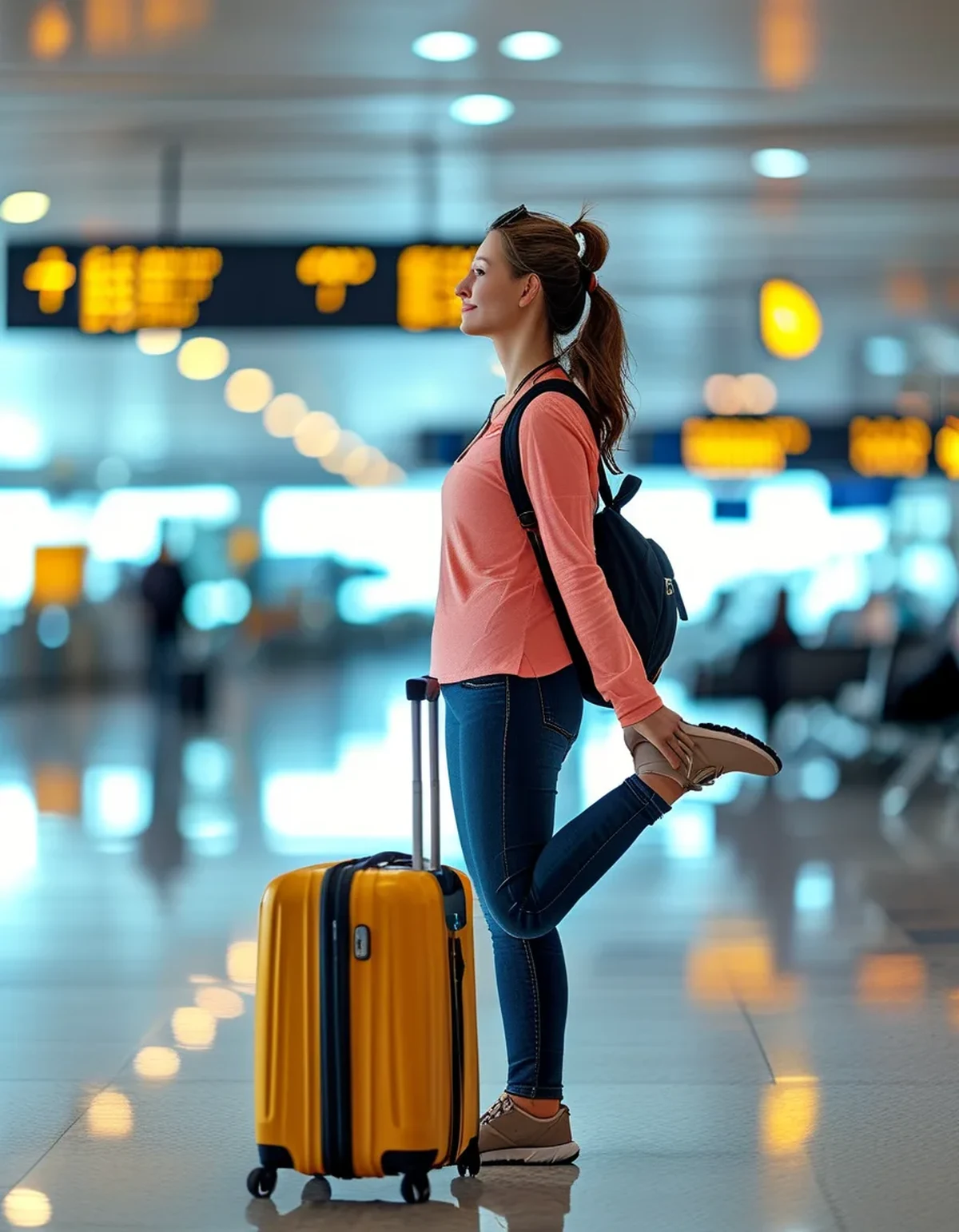
- Ankle pumps every 30 minutes. Twenty repetitions of pointing and flexing your feet, plus twenty ankle circles each direction. This directly reactivates the calf pump and it is the single most effective thing you can do from a seat.
- Graduated compression socks, 15 to 20 mmHg. Put them on before you leave the house, not once your ankles have already swollen. Graduated means tighter at the ankle and looser upward, which is the direction that helps.
- Stand and walk every 60 to 90 minutes where possible. Even two minutes in the aisle or at a rest stop resets things substantially.
- Hydrate deliberately. Roughly 8 ounces of water per hour of flight, and moderate alcohol and caffeine, both of which work against you.
- Get your feet off the floor when you can. Elevating even slightly with a bag under your feet helps; fully reclining with legs up during a layover helps a lot.
Number one is free, invisible to everyone around you, and most people never do it once.
What helps after you land?
The swelling resolves on its own for most people, but you can speed it up considerably:
- Walk for 10 to 15 minutes as soon as practical after arriving. This is the fastest reset — the pump does the work, not any technique
- Legs up the wall for 10 minutes. Lying on your back with legs vertically against a wall uses gravity in your favor
- Keep the compression socks on for a few hours after landing rather than pulling them off immediately
- Hydrate and go easy on salt for the first day, which is often the opposite of what a travel day’s food looks like
- Calf raises, 2 sets of 20, in your hotel room. Direct, targeted pump activation
Skip the sauna or hot bath on arrival — heat causes vasodilation and can temporarily worsen swelling. A cool shower is the better choice.
Most travel swelling resolves within 12 to 24 hours. If it persists past a couple of days, is one-sided, or comes with pain, get it checked.
FAQ: Travel Swelling Questions, Answered
Do compression socks really work or is it marketing?
For travel swelling specifically, graduated compression has reasonable support for reducing lower-leg swelling during long flights. The 15 to 20 mmHg range is the usual travel recommendation; higher grades are medical products and worth discussing with a clinician.
Should I take a diuretic or supplement before flying?
No, not without medical guidance. Diuretics can worsen dehydration, which contributes to the underlying problem rather than solving it.
Why do my hands swell too on long flights?
Same mechanism, different limb — hands hanging at your sides with minimal movement plus fluid shifts. Making a fist repeatedly and raising your arms occasionally helps.
If swelling affects one leg only, or comes with calf pain, warmth, redness, or shortness of breath, seek medical care promptly.
TL;DR:
- The calf muscle pump moves fluid upward and only works when your calves contract
- Sitting still for hours turns it off; cabin pressure, dry air, and salty food add to it
- Ankle pumps every 30 minutes and 15 to 20 mmHg graduated compression prevent most of it
- Walk on arrival, elevate legs, and skip the hot bath
Set a 30-minute repeating timer for your next long trip. Twenty ankle pumps each time, and most people notice a completely different pair of ankles on landing. General information, not medical advice — one-sided swelling with pain needs prompt medical attention.
Keep Reading
This article is for general informational purposes only and is not medical advice. Always consult a qualified health professional for guidance specific to you.