Why Compression Helps Some Days and Not Others
Quick Answer: Compression works by preventing fluid accumulation, not by removing fluid that has already accumulated. Put on before swelling develops it is highly effective; put on over already-swollen tissue it feels tight and does much less. The single biggest variable is what time of day you put them on.
Same socks, same legs, completely different result.
One day they are the reason your legs feel fine at 6pm. Another day they feel like a constriction you cannot wait to remove, and your ankles are puffy anyway.
The garment did not change. What changed is when you put it on, and understanding why makes compression far more reliable.

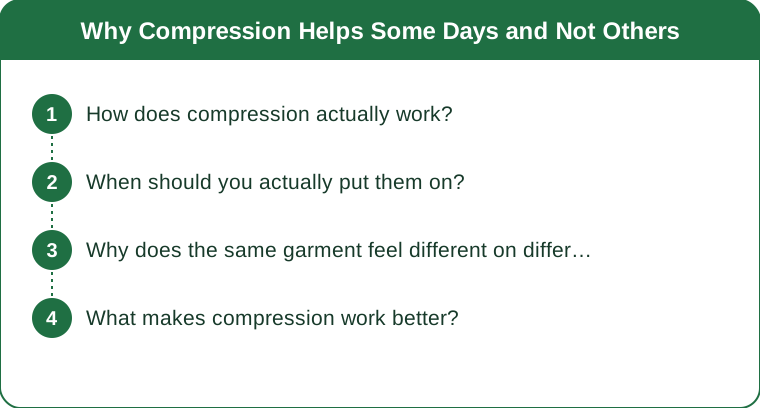
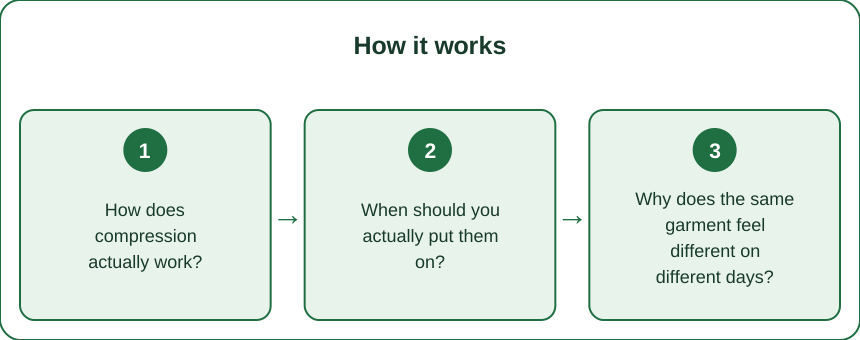
How does compression actually work?
By assisting a system that has no pump of its own.
Your lymphatic system moves fluid from tissue back toward the bloodstream, and unlike the circulatory system it has no central pump. It relies on the contraction of surrounding muscles, the pulsation of nearby arteries, and one-way valves.
Compression contributes by raising the pressure in the tissue outside the vessels, which discourages fluid from leaking out of capillaries in the first place and helps push what is there back into the lymphatic and venous return.
Graduated compression — tighter at the ankle, decreasing upward — creates a pressure gradient that favors upward flow, which is why the graduation is not a marketing detail.
The critical point is prevention versus treatment. Preventing fluid from accumulating is mechanically easy; compression opposes the pressure driving it out. Removing fluid already sitting in tissue is much harder, because that fluid has to be moved back into vessels against resistance, and a garment applies pressure fairly evenly rather than pumping.
This is why the timing dominates everything else.
This is general information, not medical advice. Persistent or asymmetric swelling needs medical assessment — there are causes that require treatment rather than compression.
When should you actually put them on?
In the morning, before you have been upright for long. This is the whole answer to the inconsistency most people experience.
Overnight, lying flat, fluid redistributes and your legs are at their smallest. Applying compression at that point means it is working against fluid accumulating all day.
By midday, especially after standing or sitting, fluid has already moved into the tissue. Putting compression on then means it is trying to shift fluid that is already there — harder, less effective, and it feels tighter because your leg is genuinely larger.
The practical rule: on before you get out of bed, or within a few minutes of doing so. Not after breakfast, not after the commute.
Other timing points:
- Before a long flight or drive, not once your ankles have already swollen
- Before a long shift, not during the afternoon when it starts to bother you
- After exercise for recovery, where the evidence is more mixed but the perceived benefit is consistently reported
And take them off at night unless a clinician has specifically told you otherwise. Lying flat, the pressure gradient is not needed, and overnight wear of the wrong garment carries risk.

Why does the same garment feel different on different days?
Because your legs are genuinely different sizes on different days, by more than most people realize.
Leg volume varies substantially day to day, driven by:
- Salt intake the previous day. Sodium drives fluid retention and the effect appears the next morning.
- Ambient temperature. Heat causes vasodilation and greater capillary leakage — this is why summer swelling is worse and why a warm autumn day produces a bad leg day.
- Hormonal cycle. Fluid retention varies meaningfully across the menstrual cycle, particularly in the luteal phase.
- How long you were upright yesterday, since some fluid carries over.
- Alcohol, which affects fluid distribution and commonly produces a visibly worse morning.
- Sleep position and duration, since flat time is what clears the accumulated load.
So a garment that fits well on a low-volume day can feel excessive on a high-volume one. That variation is normal and is not a sign the compression class is wrong — though if it is consistently uncomfortable, the sizing or class probably is.
Compression classes matter. Light support in the range of 15 to 20 mmHg suits travel, standing work, and general prevention. Medical-grade classes above that are prescribed for specific conditions and should be fitted by a professional, because too much compression in the wrong context causes problems rather than solving them.
What makes compression work better?
Compression is an assistant, not a replacement, and it performs far better alongside the things the lymphatic system actually depends on.
Calf muscle activity is the real pump. The calf muscles squeeze the deep veins with every contraction, and this does more for return than any garment. Walking for a few minutes every hour outperforms wearing compression while sitting still all day — and doing both is better than either.
Ankle pumps when you cannot walk. Flexing and pointing the foot 20 times, several times an hour, activates the same mechanism. This is why it is the standard advice on long flights.
Elevation, above heart level, for 15 to 20 minutes. Gravity does the work, and it is the most effective way to reduce swelling that has already developed — the thing compression is worst at.
Hydration, counterintuitively. Dehydration promotes fluid retention rather than reducing it.
Sodium moderation, which has a next-day effect that is easy to observe once you look for it.
What nobody tells you about compression: most people size by shoe size or by height, and the measurement that actually matters is ankle circumference, taken in the morning at the narrowest point above the ankle bone. Calf circumference matters too. A garment sized by shoe size is sized by a proxy for a proxy, which is why so many people conclude compression does not work for them when they were simply wearing the wrong size. Measure once, in the morning, and it changes the experience entirely.
TL;DR:
- Compression prevents fluid accumulation far more effectively than it removes fluid already there.
- Put garments on in the morning before you have been upright — this single variable explains most day-to-day inconsistency.
- Leg volume genuinely varies with salt, heat, hormonal cycle, alcohol, and time spent upright.
- Calf muscle activity is the actual pump: walk a few minutes hourly, or do ankle pumps when you cannot.
- Elevate above heart level to reduce existing swelling, and size garments by ankle circumference measured in the morning.
Keep Reading
This article is for general informational purposes only and is not medical advice. Always consult a qualified health professional for guidance specific to you.