Legs Up the Wall: The Do-Nothing Pose With a Fan Club
Quick Answer: Lie on your back with your legs resting up a wall for 5 to 10 minutes. Elevating your legs above your heart lets fluid that pooled in your feet and ankles during the day drain back with gravity, which is why end-of-day puffiness and heavy legs ease noticeably. Sit sideways against the wall, pivot your legs up, and slide a small cushion under your hips. If your hamstrings complain, scoot back — the pose has no ambition.
Nurses do it. Runners do it. Flight attendants, pregnant women, and anyone who spent nine hours standing on a hard floor do it.
The membership fee is five minutes and any vertical surface.
Yoga’s laziest famous pose has a genuinely large fan club, and the reason isn’t mystical. It’s plumbing.

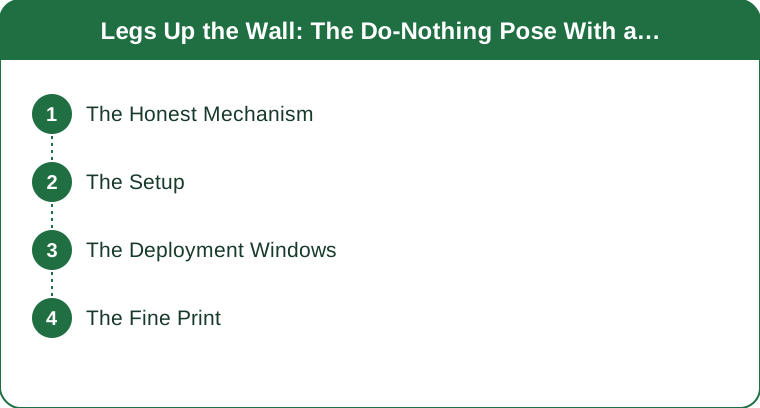
What does legs up the wall actually do?
It settles the day’s gravity bill, and that’s a more literal description than it sounds.
Over a day of standing or sitting, fluid accumulates in the lower legs, ankles, and feet. Your veins and lymphatic vessels move it back upward against gravity, assisted mainly by the calf muscles contracting as you walk. On a day with a lot of standing and not much walking — the specific combination nurses, teachers, retail workers, and flight attendants all know — that return system falls behind.
Elevating the legs above heart level reverses the slope. Fluid that pooled drains back, which is why the pose deflates end-of-day puffiness and eases the heavy-leg feeling within a few minutes.
There’s a second effect worth naming: lying still with legs supported and eyes closed tends to shift you toward parasympathetic (“rest”) activity, particularly if you lengthen your exhales. That’s why it doubles as a wind-down.
It’s plumbing, not magic. Plumbing is enough.
How do you set it up so it’s actually comfortable?
Most people make this harder than it needs to be by trying to get their hips flush against the wall.
- Sit sideways with one hip touching the wall, knees bent.
- Pivot — swing your legs up the wall as you lower your back to the floor. It’s one smooth rotation.
- Scoot to comfortable. Your hips should be near-ish the wall, not welded to it. A few inches of gap is completely fine and much easier on tight hamstrings.
- Add a small cushion or folded towel under your hips. This is the luxury edition, and it slightly increases the elevation.
- Arms out wide, palms up, eyes closed. Set a timer for 5 to 10 minutes.
If your hamstrings complain, slide farther from the wall. That’s it — that’s the whole adjustment. This pose has no ambition and nothing to prove. A version with your legs at 60 degrees and your hamstrings quiet is better than a version at 90 degrees that you abandon after 90 seconds.
No wall available? Legs up on a couch cushion, a chair seat, or a stack of pillows does most of the same job.
When is the best time to do it?
Five windows where it earns its reputation.
- After a long standing day. The nurse-and-teacher classic. This is the use case with the most obvious payoff — the difference is usually noticeable within about three minutes.
- After a run or a hike. The athlete’s dessert. It won’t speed recovery in any dramatic way, but it’s pleasant and it takes the swelling edge off.
- After a flight or a long drive. Hours of sitting with your legs down is the ideal setup for pooling. Ten minutes on arrival helps a lot.
- On hot evenings. Heat causes blood vessels to dilate, which is why ankles swell more in summer. This is the seasonal use case, and it’s why the pose gets popular in August.
- Before sleep. Pair it with long slow exhales — four counts in, six or eight counts out — and it becomes a legitimate nervous-system downshift rather than just leg drainage.
Who should skip it or modify it?
Short list, worth reading.
Modify or skip if you have glaucoma or elevated eye pressure, or unmanaged high blood pressure — inversions, even mild ones, have opinions about both. If you’re unsure, this is a two-minute question for your doctor.
Pregnancy: later in pregnancy, lying flat on your back can compress the vena cava. A slightly reclined variation with the torso propped, or a side-lying version with legs elevated, is generally preferred. Ask your provider for guidance specific to your stage.
Persistent one-sided swelling is a clinician matter, not a wall matter. Swelling in one leg — particularly with warmth, redness, or pain — can indicate a blood clot and warrants prompt medical attention rather than a restorative pose. The same applies to swelling that doesn’t resolve overnight, comes with shortness of breath, or is new and unexplained.
For ordinary end-of-day heaviness in both legs, the wall is open.
Myth vs Fact
Myth: Legs up the wall detoxes your lymphatic system. Fact: It assists fluid return with gravity, which is real and useful. “Detox” isn’t a thing your lymphatic system needs help with.
Myth: Longer is better — 30 minutes beats 10. Fact: Most of the benefit arrives in the first 5 to 10 minutes. Longer is fine if it’s comfortable, but it isn’t more effective.
Myth: Your hips must be flat against the wall. Fact: A few inches of gap is both acceptable and more comfortable for most people. Forcing the position mostly produces hamstring strain.
Myth: It replaces compression socks for swelling. Fact: It’s a complement, not a substitute. If you’re prone to significant swelling, compression during the day does more than elevation at night.
Myth: It’s only for yoga people. Fact: It’s a physiological position, not a practice. Its biggest fan bases are nurses and flight attendants, not yoga studios.
FAQ
How long should you keep your legs up the wall?
Five to ten minutes is the standard range and captures most of the benefit. Longer is fine if it’s comfortable, though beyond about 15 minutes some people get pins and needles in their feet as circulation adapts — if that happens, come down and shake your legs out. Daily is perfectly reasonable.
Does legs up the wall help with swollen ankles?
For ordinary end-of-day swelling in both legs from standing, sitting, or heat, yes — elevating above heart level lets pooled fluid drain back and the effect is usually noticeable within minutes. It does not address underlying causes, so swelling that’s persistent, one-sided, painful, or accompanied by redness or shortness of breath needs medical assessment rather than elevation.
Is legs up the wall good before bed?
It works well as a wind-down, particularly combined with slow lengthened exhales, since lying still with the legs supported shifts you toward parasympathetic activity. Many people find it more effective than stretching for pre-sleep because it requires no effort and no attention. Doing it in bed with legs against the headboard or on a stack of pillows works if a wall isn’t convenient.
TL;DR:
- Elevating legs above heart level lets pooled fluid drain back — it’s gravity, not magic.
- Sit sideways, pivot up, scoot until comfortable, cushion under the hips. 5–10 minutes.
- Hips don’t need to touch the wall. Hamstrings complaining means slide back.
- Best after long standing days, runs, flights, hot evenings, and before sleep.
- Pair with long exhales for an actual nervous-system downshift.
- Modify for glaucoma, unmanaged blood pressure, and later pregnancy — ask your provider.
- Persistent or one-sided swelling is a clinician matter, not a wall matter.
Keep Reading
This article is for general informational purposes only and is not medical advice. Always consult a qualified health professional for guidance specific to you.