Does Crossing Your Legs Actually Cause Swelling? What the Position Really Does
Quick Answer: Crossing your legs does briefly raise pressure and restrict flow in the compressed leg, but the effect is small and reverses as soon as you uncross. What actually causes evening swelling is sitting still for hours in any position — the calf muscle pump stops working and fluid pools by gravity. Position matters far less than movement does.
The advice to uncross your legs has been passed down for generations as a circulation warning.
The measurements say something more nuanced: the position is a minor factor, and the stillness it usually accompanies is the major one.

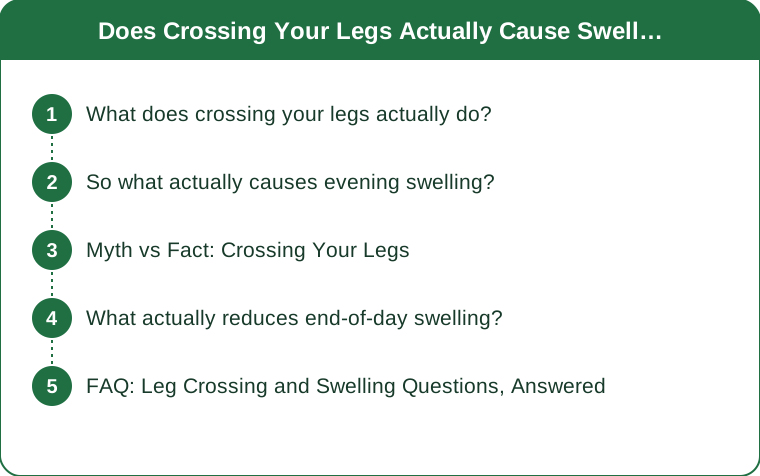
What does crossing your legs actually do?
Something real but modest, and largely reversible.
It raises blood pressure temporarily. Crossing at the knee produces a measurable rise in blood pressure while you hold it, which resolves within minutes of uncrossing. This is a well-documented effect and it is why clinical guidelines specify feet flat on the floor when taking a blood pressure reading.
It compresses veins in the upper leg. Crossing at the knee applies pressure at the point of contact, which restricts venous return from the lower leg on the crossed side. Crossing at the ankle produces far less compression.
It restricts lymphatic flow at the same point. Lymphatic vessels are thin-walled and low-pressure, so they are compressed even more easily than veins are. Sustained pressure at the knee or the back of the thigh does impede drainage.
But the effect is short-lived and small. Uncross, move, and the flow resumes. For most people without an underlying vascular condition, occasional leg crossing is not a meaningful contributor to anything.
The real problem is what usually accompanies it: you cross your legs when you are settled in, which means you are about to be still for a while. It is the stillness that produces the swollen ankles at 5pm, not the position itself.
So what actually causes evening swelling?
Three things, in order of importance.
The calf muscle pump stops working. Your lymphatic system has no central pump — it relies on muscle contraction, breathing, and one-way valves to move fluid upward against gravity. Every step you take squeezes the deep veins and lymphatic vessels in your calf and pushes fluid toward your heart. Sit still and that pump is simply off.
Gravity does the rest. Fluid moves toward the lowest point, which when you are seated is your feet and ankles. Over eight hours, that accumulation is substantial and it is why swelling is worse at the end of the day and gone by morning.
Pressure at the back of the thigh. A chair edge pressing into the underside of your thigh does more compression damage than crossing your legs does, and it is sustained for far longer. Chair height that leaves your feet dangling is a bigger culprit than any leg position.
Heat and salt amplify it. Warm weather causes vasodilation, which increases fluid movement into the tissues. Late-summer swelling is genuinely worse than winter swelling for this reason, and higher sodium intake compounds it.
The practical implication is that changing your position without changing your movement fixes very little.

Myth vs Fact: Crossing Your Legs
Myth: Crossing your legs causes varicose veins. Fact: There is no good evidence for this. Varicose veins are driven mainly by genetics, age, pregnancy, prolonged standing, and valve failure in the veins. Leg crossing is not on the list of meaningful contributors, and this particular piece of folk wisdom has been repeated for decades without support.
Myth: It permanently damages circulation. Fact: The effects are transient. Blood pressure normalizes within minutes and flow resumes on uncrossing. There is no cumulative damage mechanism from ordinary leg crossing.
Myth: Sitting with feet flat solves swelling. Fact: It is better than crossed, and it does not solve anything by itself, because the calf pump is still off. Feet flat and motionless for three hours still produces swelling.
Myth: Swelling means something is wrong with your circulation. Fact: Mild, symmetrical, end-of-day swelling that resolves overnight is normal physiology, especially in hot weather. Persistent swelling, one-sided swelling, or swelling with pain, redness, or warmth is a different matter entirely and needs medical attention.
Myth: Crossing at the ankle is just as bad. Fact: It is considerably less compressive, since there is much less soft tissue and vessel volume being squeezed at the ankle than at the knee. If you find crossing comfortable, crossing at the ankle is the lower-cost version.
What actually reduces end-of-day swelling?
Movement, positioning, and a couple of things that punch above their weight.
Calf raises at your desk, hourly. Twenty calf raises takes thirty seconds and directly activates the pump that has been off. This is the single highest-return intervention and it requires nothing.
Stand or walk for two minutes every hour. Even a walk to the water cooler restores flow for a while. Setting an actual reminder is what makes this happen, because you will not remember on your own.
Fix your chair height. Feet flat on the floor with thighs roughly parallel to the ground, and no pressure at the back of the knee. If your feet dangle, get a footrest. This is a bigger factor than leg crossing by a wide margin.
Elevate at the end of the day. Legs above heart level for ten to fifteen minutes lets gravity work in your favor for once. Legs up the wall is genuinely effective, and it is more effective before the swelling peaks than after.
Compression socks if you sit or stand all day. Graduated compression supports venous return mechanically. They are the difference-maker for people whose jobs do not allow movement.
Diaphragmatic breathing. Deep breathing creates pressure changes that assist lymphatic return through the thoracic duct. A few minutes of slow breathing does more than most of the tools sold for this purpose.
This is general information, not medical advice. Swelling in one leg only, swelling with pain or warmth, sudden swelling, or swelling accompanied by breathlessness needs prompt medical evaluation — those can indicate a blood clot or a cardiac issue.
FAQ: Leg Crossing and Swelling Questions, Answered
Should I stop crossing my legs entirely?
For most healthy people, it is not necessary. If you have varicose veins, existing lymphedema, or a history of clots, avoiding sustained compression is a reasonable precaution and worth discussing with your doctor. For everyone else, the more useful habit is changing position often, whichever positions you use.
Why is swelling worse in late summer?
Heat causes blood vessels to dilate, which increases fluid movement into surrounding tissue, and you are also more likely to be dehydrated, which paradoxically makes the body retain fluid. Late summer is peak season for this, and it usually improves noticeably as temperatures drop through September.
Do lymphatic massage tools help with this kind of swelling?
For ordinary end-of-day fluid pooling, walking and elevation outperform any tool, because the mechanism is mechanical and gravitational. Manual lymphatic drainage has genuine clinical uses, particularly for diagnosed lymphedema, but for a desk worker with puffy ankles at 6pm, the calf pump is the intervention.
TL;DR:
- Crossing your legs raises blood pressure briefly and compresses veins on that side, but the effect reverses on uncrossing
- Evening swelling is caused by stillness, not position — the calf muscle pump is what moves fluid upward and sitting turns it off
- Chair height and pressure behind the knee matter more than leg position does
- Calf raises every hour, two minutes of walking, elevation at the end of the day, and compression if you cannot move
Your grandmother was right that something about sitting was the problem. It was just the sitting rather than the crossing.
Keep Reading
This article is for general informational purposes only and is not medical advice. Always consult a qualified health professional for guidance specific to you.